This may be the last time I get to use internet until I get back to the States... so I guess I will see you soon and can update you on all my "Top10s" and adventures.
Sala kahle!
Wednesday, June 23, 2010


Tuesday, June 22, 2010
Makoti
I keep saying that I want a Zulu wedding because I love how inclusive it is—anyone who wants to come and share your happiness, comes. Unfortunately this is not really possible in the States. Where is it not likely that the entire neighborhood and all female friends are likely to spend the entire weekend happily cooking for all these people.
If the wedding in itself is not hard to bring state-side, the traditions are. I already told you all about beading ucu and putting up the white flag, paying labola and the umbondo ceremony, but I seemed to have forgotten an important part of this process—being a makhoti. Perhaps I let this slip my mind because if future in-laws did decide they wanted to do things Zulu-style, I would be in trouble.
Before a woman is to become a man’s wife, she endures the makhoti period. In essence, I guess “makhoti” could stand in for the western “fiancé,” but it comes with more responsibility. It is a trial period for the wife-to-be, living alone with her future in-laws and abiding by their every wish. This includes waking up early every morning to make their tea, iron their clothes, draw their baths. Tasks can include re-plastering their floors—floors that are made by relayering it with cow dung every year. The makhoti answers to her in-laws every beck and call. If they chose, their makhoti can become close to a slave, but I am sure they are usually not that cruel. This lasts until the parents decide that the bride-to-be is a fit for their family and can handle the tasks that might await her.
Eek! It is kind of funny, but probably because I don’t have to do it [I don’t think?].
What made me think of this was last Sunday at Mtho’s party. I wore a scarf on my head, which traditionally married women are to wear, but also makhotis—and with my young face, I looked like I was a makhoti, as all the older women insisted on telling me. I wrapped my hair because 1. I couldn’t figure out how to wash my hair while crouching in that little tub and trying to bathe myself, and 2. because if I showed all the signs of being married, perhaps no one [i.e. men] would talk to me.
Well, my plan was only a bit successful as a guy being introduced to me said, “Ngiyakuthanda” within 30 seconds of shaking hands, expressing his love for me before proposing. Of course he was joking. But his mother, who I met a few hours later, was not.
“Hello, I am Denti. I would like to be your friend. Can we exchange phone numbers?” phone numbers are exchanged. “That right there is my son.” I notice her pointing to the guy with the machete, hacking at the slaughtered cow, and then realize he is the same guy who proposed to me earlier. “Yes, my son. That is my son. He is very nice, yes, very nice. He is going to the University of Natal! To get his degree! Yes, yes. That is my son, right there. You see him? He is strong. Very, very strong. Did you meet my son?” A smile from her as she takes my hand and leads me closer to the skinned cow and the young man cutting it. “Yes, right here, this is my son. Very nice, very strong.”
If the wedding in itself is not hard to bring state-side, the traditions are. I already told you all about beading ucu and putting up the white flag, paying labola and the umbondo ceremony, but I seemed to have forgotten an important part of this process—being a makhoti. Perhaps I let this slip my mind because if future in-laws did decide they wanted to do things Zulu-style, I would be in trouble.
Before a woman is to become a man’s wife, she endures the makhoti period. In essence, I guess “makhoti” could stand in for the western “fiancé,” but it comes with more responsibility. It is a trial period for the wife-to-be, living alone with her future in-laws and abiding by their every wish. This includes waking up early every morning to make their tea, iron their clothes, draw their baths. Tasks can include re-plastering their floors—floors that are made by relayering it with cow dung every year. The makhoti answers to her in-laws every beck and call. If they chose, their makhoti can become close to a slave, but I am sure they are usually not that cruel. This lasts until the parents decide that the bride-to-be is a fit for their family and can handle the tasks that might await her.
Eek! It is kind of funny, but probably because I don’t have to do it [I don’t think?].
What made me think of this was last Sunday at Mtho’s party. I wore a scarf on my head, which traditionally married women are to wear, but also makhotis—and with my young face, I looked like I was a makhoti, as all the older women insisted on telling me. I wrapped my hair because 1. I couldn’t figure out how to wash my hair while crouching in that little tub and trying to bathe myself, and 2. because if I showed all the signs of being married, perhaps no one [i.e. men] would talk to me.
Well, my plan was only a bit successful as a guy being introduced to me said, “Ngiyakuthanda” within 30 seconds of shaking hands, expressing his love for me before proposing. Of course he was joking. But his mother, who I met a few hours later, was not.
“Hello, I am Denti. I would like to be your friend. Can we exchange phone numbers?” phone numbers are exchanged. “That right there is my son.” I notice her pointing to the guy with the machete, hacking at the slaughtered cow, and then realize he is the same guy who proposed to me earlier. “Yes, my son. That is my son. He is very nice, yes, very nice. He is going to the University of Natal! To get his degree! Yes, yes. That is my son, right there. You see him? He is strong. Very, very strong. Did you meet my son?” A smile from her as she takes my hand and leads me closer to the skinned cow and the young man cutting it. “Yes, right here, this is my son. Very nice, very strong.”
Monday, June 21, 2010
Weekend Update: Last Weekend in KwaZulu Natal!
Let’s start with Friday. On Friday I officially said goodbye to the Thandanani staff. I gave a presentation on Thandanani as an organization and what improvements I felt could be made—this included recommendations for new volunteers and staff members in the future [these were per the director’s request]. Then I went into the more personal impact my experience had on me, called “Lessons from Thandanani: Things I didn’t know to expect.” This included expecting friends, expecting family, expecting hardships, expecting changes, expecting the unexpected… overall, I tried to convey what I had learned and applaud them for the work that they do. I ended my presentation with a R3,000 [$400 USD] donation to Thandanani’s community projects in Snathing, where I had done the Umhlaba Wami workshops. Much of the donated money came from donations to the Umhlaba Wami program, so for those of you who contributed, thank you. :)
The staff responded with memories we shared, and positive words about me being there. I am leaving knowing that I actually made an impact, and very happy that I came. I really am going to miss the comfort and the friendships made, and especially the work that I was doing in the communities. Below you see a picture with most all of the staff at Thandanani that day… and you can see why they call me “the mlungu” [white person], despite the fact that I think my skin is pretty tan.

 Agnes, a staff member at Thandanani, decided that she wanted to take me home that weekend. We went to her house in the township of Dambuza, where I had gone with her in the beginning of my stay to do Thandanani home visits with caregivers. The next night we went to Elanskop, a more rural township where her husband lives and a place where the frost bite of winter is even more apparent. I learned the ins and outs of fetching water and pit toilets, and how to cook Zulu food [pap, steamed bread (aka “dumplings), cow intestines, and cow stomach lining…. Yum?]. I also realized I had bathing troubles—in Indonesia [volunteered as an English teacher there, summer of 2006] things were quite easy as there is a bucket of water with a cup and you pour the water over you like a shower. The water splashes all over the floor and flows into the drain. In both places you warm the water up in the kettle so you have some hot water. But here, you actually stand in your bucket, and you are bathing in the middle of the bedroom, so you cannot splash all over the floor. Plus, it is a freezing cold 4-degrees Celsius… and you are standing unclothed in a bucket, desperately trying to figure out how to not splash on the floor while still managing to wash anything above your ankles.
On Sunday we went to Mthobisi’s house [another Thandanani staff member] for a function. Here is a way that not knowing about a culture can make you feel pretty stupid. A conversation with Mthobisi on Friday:
Brittan: Hey! I am going with Agnes and Jilleth to your party on Sunday!
Mtho: Really? That’s great, gal.
Brittan: So, what is it for exactly?
Mtho: It is my sister’s unveiling.
Brittan: So what is that? A coming of age party? Something to do with a wedding?
Mtho: No, no gal. My sister is coming home.
Brittan: Oh! So should I have an unveiling when I go back to the States? Yay! I get a party!
Mtho: What? No, no. Gal, you’re crazy.
Brittan: But I wanted a party. And I am coming home, too. So I should have an unveiling.
Mtho: No, an unveiling in my culture with a year after someone dies, you unveil their tombstone and slaughter a cow. My sister is dead, gal.
Brittan: Oh.
Yes, I felt stupid. Fortunately, we all laughed it off. Maybe I shouldn’t ask so many questions.
 Mtho’s house was bulging with people when we got there on Sunday. Hundreds of people crammed into a tiny space, and on one side everyone seemed to be wearing lots of white. It is because her mom is Shembe, a very traditional Zulu religion, and they wear white—being Shembe is also why she had to have the celebration on Sunday [Father’s Day], because the Shembe do not work on Saturdays, and this would have included cooking. The Shembe women wear beautifully beaded white hats, and with so many of them around you cannot miss them. As they left, they danced away from the house with a guy playing a drum [practically made with duct tape, hitting it with an empty Coke bottle], and two girls in white playing a long horn, looking like an elongated metal vuvuzela [the Shembe claim they were the originators of the vuvuzela]. They kind of looked like the angel Moroni on top of LDS temples. The sound was simple, yet really awesome.

 Unfortunately [or, perhaps fortunately] I missed the ceremonial stuff, which included the slaughtering of a cow. I watched a sheep get slaughtered at Thabani’s sister’s umbondo, but I didn’t know if I could handle a cow. But I ate the cow, and it tasted quite good. The room I was sitting in was next to the room that had the carved cow meat in there, and every time someone walked in and out of the door [which was every few seconds], I got a whiff of the raw meat smell. I couldn’t even feel sad for myself, because all this was happening in someone’s bedroom, and I have a feeling that their clothes and will smell of slaughtered cow for a very long time.
It was a good last weekend in KwaZulu Natal. I went to church that evening and said goodbye to everyone, except my Bible study group which I invited over for pizza on Wednesday. Ah! My last Sunday! This Friday I take a bus to Johannesburg, and a week later I am on a plane to America! Wow.
I know so many of you are itching for all the updates from my camping trip. Well… it will come in due time, but perhaps not until I get back to the States where I can sit in the library for hours on end and use their wireless internet to upload all the [bajillions] of photos.
The staff responded with memories we shared, and positive words about me being there. I am leaving knowing that I actually made an impact, and very happy that I came. I really am going to miss the comfort and the friendships made, and especially the work that I was doing in the communities. Below you see a picture with most all of the staff at Thandanani that day… and you can see why they call me “the mlungu” [white person], despite the fact that I think my skin is pretty tan.


On Sunday we went to Mthobisi’s house [another Thandanani staff member] for a function. Here is a way that not knowing about a culture can make you feel pretty stupid. A conversation with Mthobisi on Friday:
Brittan: Hey! I am going with Agnes and Jilleth to your party on Sunday!
Mtho: Really? That’s great, gal.
Brittan: So, what is it for exactly?
Mtho: It is my sister’s unveiling.
Brittan: So what is that? A coming of age party? Something to do with a wedding?
Mtho: No, no gal. My sister is coming home.
Brittan: Oh! So should I have an unveiling when I go back to the States? Yay! I get a party!
Mtho: What? No, no. Gal, you’re crazy.
Brittan: But I wanted a party. And I am coming home, too. So I should have an unveiling.
Mtho: No, an unveiling in my culture with a year after someone dies, you unveil their tombstone and slaughter a cow. My sister is dead, gal.
Brittan: Oh.
Yes, I felt stupid. Fortunately, we all laughed it off. Maybe I shouldn’t ask so many questions.


 Unfortunately [or, perhaps fortunately] I missed the ceremonial stuff, which included the slaughtering of a cow. I watched a sheep get slaughtered at Thabani’s sister’s umbondo, but I didn’t know if I could handle a cow. But I ate the cow, and it tasted quite good. The room I was sitting in was next to the room that had the carved cow meat in there, and every time someone walked in and out of the door [which was every few seconds], I got a whiff of the raw meat smell. I couldn’t even feel sad for myself, because all this was happening in someone’s bedroom, and I have a feeling that their clothes and will smell of slaughtered cow for a very long time.
 It was a good last weekend in KwaZulu Natal. I went to church that evening and said goodbye to everyone, except my Bible study group which I invited over for pizza on Wednesday. Ah! My last Sunday! This Friday I take a bus to Johannesburg, and a week later I am on a plane to America! Wow.
I know so many of you are itching for all the updates from my camping trip. Well… it will come in due time, but perhaps not until I get back to the States where I can sit in the library for hours on end and use their wireless internet to upload all the [bajillions] of photos.
Friday, June 18, 2010
Journalism
I just walked into the internet cafe [I am here too often, so they know me well], to hear everyone working say, "Hey!!! We saw you in the newspaper!" with giant South African smiles. Well, here is an explanation to explain what they just said:
Matthew came to Thandanani one day to interview me for a book he was writing on the foundations behalf. He said he had come to know me through my blog posts on the Thandanani. A writer for the local newspaper, he invited me to write a feature article for the Witness. Wo0o0oo! Thinking that journalism could be one of my secret callings, I was incredibly excited to have the opportunity to write for a real newspaper! But then I realized that writing feature articles is much harder than writing news [as I had done on the CNN website]—when you write the news, you already have a subject to write about and it is gathering the facts and strategically presenting them. Feature articles, on the other hand, have no focus—you write on whatever you want and hope that other people will find it interesting.
While in Namibia, the first week of my Awesome African Camping Adventure, I got a text message from a friend from church saying that she had seen my face on the front page of the newspaper. She read my article and “I am so happy to call you my friend.” I was thrilled that they actually decided to publish my article!
Take this link to a PDF version of my article or look below. Unfortunately I didn’t return to Pietermaritzburg until more than a month after it was published, so I do not have a hard copy of it. But I am so happy that I am getting so many unique opportunities here!
Smith Article
Matthew came to Thandanani one day to interview me for a book he was writing on the foundations behalf. He said he had come to know me through my blog posts on the Thandanani. A writer for the local newspaper, he invited me to write a feature article for the Witness. Wo0o0oo! Thinking that journalism could be one of my secret callings, I was incredibly excited to have the opportunity to write for a real newspaper! But then I realized that writing feature articles is much harder than writing news [as I had done on the CNN website]—when you write the news, you already have a subject to write about and it is gathering the facts and strategically presenting them. Feature articles, on the other hand, have no focus—you write on whatever you want and hope that other people will find it interesting.
While in Namibia, the first week of my Awesome African Camping Adventure, I got a text message from a friend from church saying that she had seen my face on the front page of the newspaper. She read my article and “I am so happy to call you my friend.” I was thrilled that they actually decided to publish my article!
Take this link to a PDF version of my article or look below. Unfortunately I didn’t return to Pietermaritzburg until more than a month after it was published, so I do not have a hard copy of it. But I am so happy that I am getting so many unique opportunities here!
Smith Article
Wednesday, June 16, 2010
At Home in Snathing
On April 30th, the last Friday before my big trip [aka the Awesome African Camping Adventure] will be one of my best memories of my time in South Africa Ingqwangele High School
When we entered Snathing, I instantly felt comfortable in my environment—I knew where we were as I had traveled down those same roads dozens of times before. I recognized the potholes in the dirt roads, the bright clothing hanging on barbed wire, the mud houses spread on rolling green hills. I waved to the children at the crèche as we passed and they chased the car on the side to make sure I saw that they were waving back. And I loved their smiles. I could smell the lush vegetation, the burning fires, the cooking pap. I remembered how these communities were never void of music as radios blasted from small mud huts and women sang as they gathered water. I could almost feel Snathing.
Once we got closer to the school I saw students that I recognized, either from my workshops in Ingqwangele or from the therapeutic camp last December. Teenage boys yelled my name and waved their arms as I passed. As we got closer to the school I watched as school girls danced outside a local shabeen and loads of students hung around various tuck shops [the school had sent half of the students home that day due to some registration chaos].

Once dropped off at Ingqwangele, I felt as if I was back in my zone. I used my Zulu to greet the woman opening the school fence. I chatted with Mr. Ngcobo [who was thrilled with the success of Umhlaba Wami: “I never thought it would be so successful! In the museum, in the newspaper!”]. I showed Morgan around the school and remembered the first time I went by myself. Then the class breaks happened and students came pouring out of their classrooms.

At first I saw Bonginkosi. Then my students from Umhlaba Wami slowly realized I was there and started coming over. Their friends followed, as they were incredibly curious because the random white/coloured girl had brought another random white/coloured girl. I talked to the kids and introduced Morgan, happy to share this experienced with a friend. My favorite moment was when Zimbili came running from the other side of the school to give me a big hug and say thank you. Nothing has ever made me feel so good.
 I cannot verbally describe the impact of these moments. Of turning something incredibly foreign into something that makes you the most comfortable. Of taking strangers and making friends. Of feeling that you have made a positive impact in someone’s life. I do not know how to paint a picture of the warm feelings I felt that day, but I can tell you that it was when I realized that this was an experience that I would really miss. I have never felt more fortunate that I was able to do the Umhlaba Wami program.
We took a kombi [mini bus taxi] back into town and as the dirt roads became paved and the cows and goats in the road were replaced with stop lights, I felt a slight tug of my heart—I had a feeling I would not be going back there anytime soon. I do not know if the memories of me will fade from that community as quickly as they emerged, but I know that my experiences there will permanently be etched into my heart.
Youth Day
I would like to wish everyone out there a Happy Youth Day, which is a public holiday today in South Africa. Unlike the more joyful Youth Days around the world that celebrate children just as they do fathers and mothers, South Africa's Youth Day actually stems from darker apartheid times. This day seems to be more a day of remembrance than one of celebration, but a holiday that will show that young people can change our world.
Youth Day commemorates the start of the Soweto riots of 1976, initially sparked by a government edict that all instruction in black schools would be held in Afrikaans. The iconic picture of Hector Pieterson, a black schoolchild shot by the police, brought home to many people within and outside South Africa the brutalities of the Apartheid regime.
 I know it might be a lot to read, but it is very interesting-- a quick history, provided by Wikipedia:
The origin of the protests are traced back to 1949 and the Eiselen Commission's inquiry into the edification of non-whites. The commission recommended drastic changes, which were implemented through the Bantu Education Act of 1953. The legislation caused many mission schools, through which the majority of black children were educated, to lose government aid and close. Funding for black schools was drawn from taxes paid by black people, who were generally impoverished. The result was a very uneven distribution of teaching resources in black and white schools.
 Black students in Soweto protested against the Afrikaans Medium Decree of 1974 which forced all black schools to use Afrikaans and English in a 50-50 mix as languages of instruction. A 1972 poll had found that 98% of young Sowetans did not want to be taught in Afrikaans.[citation needed] The association of Afrikaans with apartheid prompted black South Africans to prefer English. Even the homelands regimes chose English and an indigenous African language as official languages. In addition, English was gaining prominence as the language most often used in commerce and industry. The 1974 decree was intended to forcibly reverse the decline of Afrikaans among black Africans. The Afrikaner-dominated government used the clause of the 1909 Constitution that recognized only English and Afrikaans as official languages as pretext to do so. Punt Janson, the Deputy Minister of Bantu Education at the time, was quoted as saying: "I have not consulted the African people on the language issue and I'm not going to." The decree was resented deeply by blacks as Afrikaans was widely viewed, in the words of Desmond Tutu, then Dean of Johannesburg as "the language of the oppressor". Teacher organizations such as the African Teachers Association of South Africa objected to the decree.
The resentment grew until April 30, 1976, when children at Orlando West Junior School in Soweto went on strike, refusing to go to school. Their rebellion then spread to many other schools in Soweto. A student from Morris Isaacson High School, Teboho 'Tsietsi' Mashinini, proposed a meeting on June 13, 1976, to discuss what should be done. Students formed an Action Committee (later known as the Soweto Students’ Representative Council)[4] that organized a mass rally for June 16 to make themselves heard.
On the morning of June 16, 1976, thousands of black students walked from their schools to Orlando Stadium for a rally to protest against having to learn through Afrikaans in school. The protest was intended to be peaceful and had been carefully planned by the Soweto Students’ Representative Council’s (SSRC) Action Committee, with support from the wider Black Consciousness Movement. Teachers in Soweto also supported the march after the Action Committee emphasized good discipline and peaceful action.
Tsietsi Mashininini led students from Morris Isaacson High School to join up with others who walked from Naledi High School [6]. The students began the march only to find out that police had barricaded the road along their intended route. The leader of the action committee asked the crowd not to provoke the police and the march continued on another route, eventually ending up near Orlando High School. The crowd of between 3,000 and 10,000 students made their way towards the area of the school. Students sang and wove placards with slogans such as, "Down with Afrikaans", "Viva Azania" and "If we must do Afrikaans, Vorster must do Zulu".
 The rioting continued and 23 people, including two white people, died on the first day in Soweto. Emergency clinics were swamped with injured and bloody children. It is not known how many injured children sustained bullet wounds because doctors refused to collect such details for fear that police would target the families of such children. In many cases bullet wounds were indicated on hospital records as abscesses. Emotions ran high after the massacre on June 16. Hostility between students and the police was intense, with officers shooting at random and more people joining the protesters. The township youth had been frustrated and angry for a long time and the riots became the opportunity to bring to light their grievances. The 1,500 heavily armed police officers deployed to Soweto on June 17 carried weapons including automatic rifles, stun guns, and carbines. Crowd control methods used by South African police at the time included mainly dispersement techniques, and many of the officers shot indiscriminately, killing many people.
The accounts of how many people died vary from 200 to 600. The original government figure claimed only 23 students were killed. The number of wounded was estimated to be over a thousand men, women, and children.
The aftermath of the uprising established the leading role of the ANC [African National Congress, the current ruling party with Mandela as the first president] in the liberation struggle, as it was the body best able to channel and organize students seeking the overthrow of apartheid. So, although the BCM's ideas had been important in creating the climate that gave the students the confidence to strike out, it was the ANC's non-racialism which came to dominate the discourse of liberation amongst blacks.
Happy Youth Day, everyone.
Youth Day commemorates the start of the Soweto riots of 1976, initially sparked by a government edict that all instruction in black schools would be held in Afrikaans. The iconic picture of Hector Pieterson, a black schoolchild shot by the police, brought home to many people within and outside South Africa the brutalities of the Apartheid regime.

The origin of the protests are traced back to 1949 and the Eiselen Commission's inquiry into the edification of non-whites. The commission recommended drastic changes, which were implemented through the Bantu Education Act of 1953. The legislation caused many mission schools, through which the majority of black children were educated, to lose government aid and close. Funding for black schools was drawn from taxes paid by black people, who were generally impoverished. The result was a very uneven distribution of teaching resources in black and white schools.

The resentment grew until April 30, 1976, when children at Orlando West Junior School in Soweto went on strike, refusing to go to school. Their rebellion then spread to many other schools in Soweto. A student from Morris Isaacson High School, Teboho 'Tsietsi' Mashinini, proposed a meeting on June 13, 1976, to discuss what should be done. Students formed an Action Committee (later known as the Soweto Students’ Representative Council)[4] that organized a mass rally for June 16 to make themselves heard.
On the morning of June 16, 1976, thousands of black students walked from their schools to Orlando Stadium for a rally to protest against having to learn through Afrikaans in school. The protest was intended to be peaceful and had been carefully planned by the Soweto Students’ Representative Council’s (SSRC) Action Committee, with support from the wider Black Consciousness Movement. Teachers in Soweto also supported the march after the Action Committee emphasized good discipline and peaceful action.
Tsietsi Mashininini led students from Morris Isaacson High School to join up with others who walked from Naledi High School [6]. The students began the march only to find out that police had barricaded the road along their intended route. The leader of the action committee asked the crowd not to provoke the police and the march continued on another route, eventually ending up near Orlando High School. The crowd of between 3,000 and 10,000 students made their way towards the area of the school. Students sang and wove placards with slogans such as, "Down with Afrikaans", "Viva Azania" and "If we must do Afrikaans, Vorster must do Zulu".
 The rioting continued and 23 people, including two white people, died on the first day in Soweto. Emergency clinics were swamped with injured and bloody children. It is not known how many injured children sustained bullet wounds because doctors refused to collect such details for fear that police would target the families of such children. In many cases bullet wounds were indicated on hospital records as abscesses. Emotions ran high after the massacre on June 16. Hostility between students and the police was intense, with officers shooting at random and more people joining the protesters. The township youth had been frustrated and angry for a long time and the riots became the opportunity to bring to light their grievances. The 1,500 heavily armed police officers deployed to Soweto on June 17 carried weapons including automatic rifles, stun guns, and carbines. Crowd control methods used by South African police at the time included mainly dispersement techniques, and many of the officers shot indiscriminately, killing many people.
The accounts of how many people died vary from 200 to 600. The original government figure claimed only 23 students were killed. The number of wounded was estimated to be over a thousand men, women, and children.
The aftermath of the uprising established the leading role of the ANC [African National Congress, the current ruling party with Mandela as the first president] in the liberation struggle, as it was the body best able to channel and organize students seeking the overthrow of apartheid. So, although the BCM's ideas had been important in creating the climate that gave the students the confidence to strike out, it was the ANC's non-racialism which came to dominate the discourse of liberation amongst blacks.
Happy Youth Day, everyone.
Sunday, June 13, 2010
Brittan = Slacker
I know, I know. I owe you all some great blog posts. I am getting to it. Slowly. But they will be coming!
hugs and kisses and african wishes,
Brittan
hugs and kisses and african wishes,
Brittan
World Cup Fever
You all must be curious about this fever, this World Cup mania. When I left for my trip, South Africa did not look ready to host the world. Five weeks later, the streets are lined with the South African flag, banners for the World Cup are decorating the buildings, and every business advertises some sort of “World Cup Special” in their windows. The sound of vuvuzelas become constant and the streets are filled with children playing soccer [because every school is on holiday for the World Cup]. Every commercial, newspaper article and magazine feature was about the World Cup. South Africa looked like a country ready to host the world and cheer on their team.
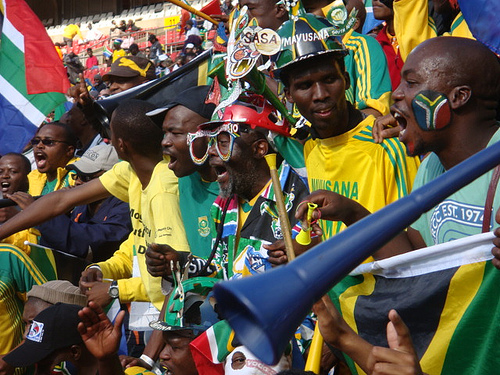
But on June 11th, a transformation happened. Driving through the town I was overwhelmed with all the yellow everyone was wearing—80% of the people were wearing their Bafana Bafana shirts to support South Africa in the opening game against Mexico. The South African flag was everywhere: painted on people’s faces, flying out of cars, wrapped around people’s bodies as dresses and capes. Vuvuzelas buzzed in the streets and makarapas [hard hats cut up and decorated] stood out in the crowds. Everyone honked their horns in celebration, not using their words but their smiles to connect with anyone dressed to support the South African team. [I will be posting pictures that I took from the car at a later date, but until then the pictures below should give you a good idea of what I was looking at!]

In our car the popular World Cup song “Wave Your Flag” was blaring in the speakers. Bongani blew my vuvuzela [which I decorated with an SA flag] out one window and I waved his full-sized SA flag out the other side. The energy from everyone was contagious. I waved that flag as much as I could, as I had never been more ‘proudly South African.’ Everyone on every street instantly became friends as they were all rooting for a single cause: South Africa. Black, White, Indian, Coloured…. Race fell away. Prejudices evaporated. The fear of AIDS and rape and crime faded with the sadness that I had seen blanketing this country’s population just months before. Everyone was united for South Africa and suddenly nothing else mattered. It was the most beautiful thing I have seen in South Africa, and suddenly it dawned on me that the South Africa I was leaving was not the same South Africa I had entered last August. The World Cup had united a country that is still trying to patch itself together, and that sight literally brought tears to my eyes. It was a new South Africa, and I had seen it with my own eyes. I pray that this World Cup will be a turning point for South Africa, and will continue this positive sense of hope long after all the soccer games have ended.
We were desperate to watch the opening game of the World Cup with other South African fans. We went to Woodburn Stadium, where they were charging R50 per person. Ha! Everyone entered the parking lot and went straight back out. We thought surely the local Harry Gwala Stadium, where they had broadcasted the rugby World Cup—and the empty stadium failed to deliver.

“Well B,” said Bongani,” we’re going to Indumiso.” He could tell I was confused. “We’re going to the township!” We drove to a soccer field that had a big screen television and a stage sponsored by Boxer, a grocery store chain. It was packed. Of course, the joining of all races I spoke of previously instantly evaporated considering that not many white, coloured, or Indian people were about to go watch the game in a township. The crowd was on fire-- marching to the soccer field, singing and blowing their vuvuzelas in sync, decked out in Bafana Bafana gear. [In case you haven’t realized, “Bafana Bafana” is the name of the South African soccer team. It translates literally into “Boys Boys.”] The energy was contagious and I was incredibly happy to be watching the opening game in the midst of South Africans. Men, women, kids of all ages, walked on dirt roads and skipped their dinners to watch this game.
 Hundreds of us stood in the field, staring at the screen, vuvuzelas buzzing as if we were at the stadium itself. The game started. The crowd watched and the noise levels were so high that I could not actually figure out which language the game was being broadcasted in despite the huge speakers facing me [and the game was to be broadcasted in all of South Africa’s 11 official languages]. Then, THEN SOUTH AFRICA SCORED THE FIRST GOAL OF THE 2010 WORLD CUP. The crowd went wild and spirits were lifted even higher than before. South Africa was excited—yes, I am going to assume that all of South Africa was as ecstatic as the group jumping around me. I don’t know how to tell you how exciting it was!
The energy continued through the game until Mexico scored… and there were too many close calls on the SA goal. The crowd fell silent [I realized we were watching the game broadcasted in English] and everyone looked up at the screen in hopes we would come back. It started to rain but everyone stood still, glued to the screen, praying we would score another goal… or rather, that Mexico would not.
The game ended 1-1, a draw between Mexico and South Africa. For most of the game, SA was winning and everyone wanted to keep it that way. Imagine the upset! What a fairytale for SA, a victory for the underdog! Doing what seemed impossible, beating all odds! It would have been amazing to win that game, but in the end we all left with a little hope in the fact that SA didn’t lose. And for that, everyone still waits for the SA vs. Uruguay game with an expectation of victory.

In case you haven’t been following the soccer craze, the USA vs. England game also ended in a 1-1 draw. Many expected England to win—and I will admit they were playing much better [the ball was mostly in their possession, they took many more shots on goal, and I kept screaming “ROONEY! GET AWAY FROM MY GOAL!!!” at the television]. But once again, I am happy we didn’t lose, as it had been predicted. Woohoo!
Halala eMelika noMzanzi! Ayoba Bafana Bafana! Laduuuuuuuuma!!!!
But on June 11th, a transformation happened. Driving through the town I was overwhelmed with all the yellow everyone was wearing—80% of the people were wearing their Bafana Bafana shirts to support South Africa in the opening game against Mexico. The South African flag was everywhere: painted on people’s faces, flying out of cars, wrapped around people’s bodies as dresses and capes. Vuvuzelas buzzed in the streets and makarapas [hard hats cut up and decorated] stood out in the crowds. Everyone honked their horns in celebration, not using their words but their smiles to connect with anyone dressed to support the South African team. [I will be posting pictures that I took from the car at a later date, but until then the pictures below should give you a good idea of what I was looking at!]

In our car the popular World Cup song “Wave Your Flag” was blaring in the speakers. Bongani blew my vuvuzela [which I decorated with an SA flag] out one window and I waved his full-sized SA flag out the other side. The energy from everyone was contagious. I waved that flag as much as I could, as I had never been more ‘proudly South African.’ Everyone on every street instantly became friends as they were all rooting for a single cause: South Africa. Black, White, Indian, Coloured…. Race fell away. Prejudices evaporated. The fear of AIDS and rape and crime faded with the sadness that I had seen blanketing this country’s population just months before. Everyone was united for South Africa and suddenly nothing else mattered. It was the most beautiful thing I have seen in South Africa, and suddenly it dawned on me that the South Africa I was leaving was not the same South Africa I had entered last August. The World Cup had united a country that is still trying to patch itself together, and that sight literally brought tears to my eyes. It was a new South Africa, and I had seen it with my own eyes. I pray that this World Cup will be a turning point for South Africa, and will continue this positive sense of hope long after all the soccer games have ended.
We were desperate to watch the opening game of the World Cup with other South African fans. We went to Woodburn Stadium, where they were charging R50 per person. Ha! Everyone entered the parking lot and went straight back out. We thought surely the local Harry Gwala Stadium, where they had broadcasted the rugby World Cup—and the empty stadium failed to deliver.

“Well B,” said Bongani,” we’re going to Indumiso.” He could tell I was confused. “We’re going to the township!” We drove to a soccer field that had a big screen television and a stage sponsored by Boxer, a grocery store chain. It was packed. Of course, the joining of all races I spoke of previously instantly evaporated considering that not many white, coloured, or Indian people were about to go watch the game in a township. The crowd was on fire-- marching to the soccer field, singing and blowing their vuvuzelas in sync, decked out in Bafana Bafana gear. [In case you haven’t realized, “Bafana Bafana” is the name of the South African soccer team. It translates literally into “Boys Boys.”] The energy was contagious and I was incredibly happy to be watching the opening game in the midst of South Africans. Men, women, kids of all ages, walked on dirt roads and skipped their dinners to watch this game.

The energy continued through the game until Mexico scored… and there were too many close calls on the SA goal. The crowd fell silent [I realized we were watching the game broadcasted in English] and everyone looked up at the screen in hopes we would come back. It started to rain but everyone stood still, glued to the screen, praying we would score another goal… or rather, that Mexico would not.
The game ended 1-1, a draw between Mexico and South Africa. For most of the game, SA was winning and everyone wanted to keep it that way. Imagine the upset! What a fairytale for SA, a victory for the underdog! Doing what seemed impossible, beating all odds! It would have been amazing to win that game, but in the end we all left with a little hope in the fact that SA didn’t lose. And for that, everyone still waits for the SA vs. Uruguay game with an expectation of victory.
In case you haven’t been following the soccer craze, the USA vs. England game also ended in a 1-1 draw. Many expected England to win—and I will admit they were playing much better [the ball was mostly in their possession, they took many more shots on goal, and I kept screaming “ROONEY! GET AWAY FROM MY GOAL!!!” at the television]. But once again, I am happy we didn’t lose, as it had been predicted. Woohoo!
Halala eMelika noMzanzi! Ayoba Bafana Bafana! Laduuuuuuuuma!!!!
Saturday, May 1, 2010
Camping Adventure: It Has Begun!
I am in Cape Town! And it has begun! See you in June! :)
[unless i find internet in the bush]
[unless i find internet in the bush]
Wednesday, April 28, 2010
An Honest Attempt to Understand Rugby

I was introduced to rugby within 24 hours of arriving in South Africa [I wrote about this experience here]. I stared intently at the television screen, trying to understand why the surrounding men were cheering at what seemed to be an outward display of testosterone. Big men in small shorts, showing off their strength and prowess through pushing around other men and performing strange tasks is all I saw. I tried to relate what I saw to a sport I was a little more familiar with: American football. I am not allowed to mention that "sissy sport" out loud during this demonstration of masculinity, not wanting to taint the moment with thoughts of men wearing helmets and pads. Apparently American football is just a "watered down version of rugby"—but you have to admit when a 160kg man is running towards you, it is a scary sight, helmet or no helmet.
As I watched the rugby game I tried desperately to understand why this sport was so popular. I eventually started understanding bits and pieces of the game, and it became more than men just hitting each other, rolling around on the ground, throwing each other in the air. Then I started thinking, what if life was one big rugby match?
If life was a rugby match, I could headbutt people whenever I needed them out of my way. If I couldn't see over the fence, a group of my friends would just hoist someone up by their shorts and that person could look for me. When there is something that I want to keep, all I need to do is lay in the fetal position on the ground as people kicked around my head, hoping my friends would come by and I could pass my treasure through their legs.
If life was a rugby match, I would always be going forward but handing things to people behind me—I could run through the grocery store and throw the bread to my friend behind me. In order for a product to be made in an assembly line, we would all have to walk forward toward the packaging as we passed backwards to finish the product. When waiting to be served at a restaurant I would be forced to stare at my waitron's rear before I received my food.
Life would be good, because if I was just physically too tired to continue with task I can call in a replacement as I sat down for a while. Someone would even bring me some water as I watched my replacement tackle the challenging tasks for me.
If I was angry at someone, I could use all my physical force to knock them to the ground, perhaps find my shoe in the eye of the person next to me. If I wanted to keep someone close, I could just pull their clothing towards me until there was no choice to be intimate. But, my life is ruled and regulated by a skinny man who decides if I have become too angry or too intimate. In that case, I will have to sit on a bench to ponder what I have done. When my time-out was over, I get to continue on with life pushing people out of the way and throwing my possessions behind me as I ran forward.
Rugby is a very strange looking sport if you have never seen it before, but now I see its practical applications to every day life. I understand why this is so popular—who wouldn't want to the opportunity to give people wedgies? And at its purist sense, rugby is organized and glorious mayhem.
Cricket on the other hand, is a whole new ballgame. Who knows how long that one will take.
Tuesday, April 27, 2010
Happy Freedom Day!

Freedom Day is an annual celebration of South Africa's first non-racial democratic elections of 1994. If you have any knowledge of South Africa's colorful history, you will understand the importance and enormity of this day. The apartheid regime grew out of Dutch colonization in the 1600s and immediately the suppression of the black majority [who were already living here on their own, mind you] started. Land was taken away, education was compromised, souls and bodies were beaten and the basic human rights were denied. It pains me to think about it, but it is a history that is not far from our own [American] history and something that I cannot ignore.
The recency of all these political events astounds me. In 1984 the government finally allowed Coloureds and Indians to vote-- but this is still leaving out the majority of those who live in South Africa. As hundreds of organizations teamed together to fight this injustice, the South African apartheid government declared a national State of Emergency in 1985 in an attempt to suppress the freedom movement. In 1988 the government started looking for a way out and started working negotiations with the African National Congress [ANC], which is the current ruling party. In 1993 a non-racial constitution was adopted and came into affect on April 27, 1994. The nation cast its first democratic election. Almost 20 million South Africans voted from a population of 38 million. Nelson Mandela was elected as the first President of South Africa.
Freedom Day.
Today, our country celebrates Freedom Day to mark the liberation of our country and its people from a long period of colonialism and white minority domination - which means that we no longer have the situation in which political power is enjoyed and exercised by a minority of our population, to the exclusion of the majority. Freedom Day is not an African National Congress day, but a day for all South Africans. When South Africa was liberated both the oppressor and oppressed were liberated. We pledge "Never again would a minority government impose itself on the majority".
I find Freedom Day to be such a significant and important day to remember. I am in awe of the fact that this is something that happened in my lifetime. One of the biggest turning points in my university education was the first day of sophomore year when I watched a documentary clip of black South Africans voting on this day 16 years ago. The woman said, "it was as if God was finally blessing His people." I even reflected upon that experience when applying for this fellowship as a reason to come to South Africa-- I wanted to see these blessing first hand.
A couple weeks ago when I listened to visiting Reverend Jesse Jackson speak, he made a valid point-- we may be free, but freedom does not mean equality. We are free to walk in the same stores and free to board the same buses. But, freedom is not equality. True freedom means an emancipation from poverty, unemployment, poor education, unwarranted violence and discrimination. Poverty is a very large issue in this country, and this issue is still largely surrounding the black people who are now "free." The problem is sudden freedoms do not erase a history of unjust discrimination and it will take decades for history to start unraveling itself, generation by generation. Diligence and a daily effort to ensure this process towards true freedom is necessary.
So on Freedom Day, South Africa takes time to remember the struggles of the not-so-distant past and hopefully renews the pledge to wipeout racism in their country [to the best of their ability-- America is 40 years ahead with a black president and I do not believe racism has been eradicated]. But I am not belittling the work that has been done, as it has been a huge step in the right direction and I believe that the end of apartheid not only changed South Africa but sent a message to the rest of the world. I applaud what has been done, and continue to do my [little] part in making sure that these promised freedoms are not just theoretical rights but those that continue to shape and improve the life of all South Africans.
I will now step off of my soapbox.
Monday, April 26, 2010
Development or Disaster?

Z dropped out of school in grade 9. He never passed academically after grade 7, but was allowed to continue on "condolences" [South African public education.... no comment] despite the fact that he only attended 50% of his classes. Z stopped going to school so he could sell newspapers and make money.
So this organization took the initiative of paying him whatever amount of money he was earning so he would go to school but not feel he was losing out financially. Not only did he not fix his poor attendance record, Z dropped out altogether.
Seeing how this didn't work, this organization then decided to find a way to put him in therapy and keep in touch with him by giving him a cell phone and an airtime starter pack so they could keep in touch with him. Not wanting to keep in touch with these people who keep pestering him about going to school, he threw away the airtime so he could buy a new starter pack [which gives him a new phone number]-- he kept the cell phone without having to keep in touch. Clever.
Z has been accused of rape. He has impregnated a 16-year old girl. He has been in trouble with the law multiple times... and this organization is looking for our help in giving him more money in hopes that he will use it to care for the girl and her child, and himself. When do pull out?
This is not an easy problem to solve by any means. When you pull out of the situation, it seems akin to "giving up." It sounds harsh to merely give up on someone because they have been struggling for a while, even when they are defiant to what you are offering. There is no simple answer, but everyone must get to a point in which they realize that money will not solve all problems.
They have been spoiling Z with money, hoping that he would change through having the finances to do so. When doing this for all these years, what happens to Z when they realize their method is not working and completely pull out financially? Nhlanhla said he felt this is a recipe for disaster-- for years he has been able to be outwardly defiant to their attempts yet keep the benefits flowing. When that gets cut 100%, what will his next move be? Perhaps we will see him change for the better in acknowledgement to the mistakes he has made; or perhaps we will see him hanging from the rafters of an abandoned building. Unfortunately the harsh imagery is more likely in these situations than the aforementioned positive.
Charity work is a lot more complex than sending money. Sometimes, a financial contribution is all that you can make, but you need to take the time to ensure that you go through the proper outlets that make that money workable. Fortunately there are good non-profit organizations who know how to make that money work in the best way possible for each case [and I may be bias in saying that Thandanani definitely does but... Thandanani definitely does]. It is also sad that this story I have told of Z's rebelliousness in a refusal to go to school and living against a rape claim is not a unique story in any way [except maybe the money being given to him] in South Africa. I hear this story so much that i fear I will one day go numb to the words that once sent me into shock and fear. There is still a long way to go in here, and we need to know what it is we as individuals can do to make progress-- inefficient fueling of money is not the right answer.
Friday, April 23, 2010
Nothing fixes a Bad Day like an Amazing Friend

Today was not the best day. In fact, as I waited in line at the post office today, right before the power went out, I considered naming today "Brittan and the Terrible, Horrible, No Good, Very Bad Day." [If you understand the reference you get brownie points from me!]. My mind was just not at a happy point.
But then I opened this box from Melissa [my neighbor and best friend for the last 15 or so years], which came just on the right day to cheer me up. No... to completely make me jump for joy in pure delight. And because of this 180-degree mood swing that she has prompted, I know I need to publicly thank her. It is not easy to quantify 15 years of friendship or mail-delivery happiness, but here is my attempt by disclosing the items of my box.
32 hair ties ["ligas" in Spanish... I don't know why I remember that]24 packs of Reese's peanut butter cups [meaning 48 Reese's peanut butter cups!]
4 chili-covered mango lollipops... Mmm Mexican candy, how I have missed you.
1 box of "Crazy Cores" Skittles [wrapped in Winnie the Pooh wrapping paper]
1 pack of Stride gum
10 issues of Seventeen Magazine [for the kids to use for their memory boxes]
4 rolls of Scotch tape
4 sheets of stickers [including American flag stickers, flower stickers and stickers in Spanish]
2 instant bite and sting relief tube things... which I will be using on my spider bite in a few minutes
10 DVDs! Yay!
22 dollars of promised donation to the Umhlaba Wami Photography Project
1 wonderful Christmas/Birthday card in Spanish and English
I promptly shared my Reese's with others in my office, exclaiming "Happy Friday, straight from America!" and they thought the candy was divine. I am just so happy that I have friends and family caring for me back home, whose love seems to come with perfect timing. Unfortunately my mother's package that was supposed to arrive 2 months ago was eaten up by the African Mail Monster it seems, but I know it would have been great... and considering that Melissa has been my neighbor for over 1.5 decades, I know some of my mother's love is included!
Bowling in Style
Last night I went bowling with the ladies at my church. I scored 111 points, which although not impressive, if you know me then you know that is pretty darn good for me. What lead me to such a great score? My outfit, of course.


Thursday, April 22, 2010
CAMPING ADVENTURE!

So to spare the long details, this is my plan for my weeks as a nomadic adventurer:
May 2-3: South Africa-- Start in Cape Town [will fly there the day before]. Views of Table Mountain from Table Bay. Camp on the Orange River, which is South Africa's longest river and the river that forms the border between South Africa and Namibia.
May 4-13: Namibia-- See the beautiful river valley by canoe. Namib-Naukluft National Park. Watch sunrise on the giant Sossusvlei Sand Dunes. Cross the Tropic of Capricorn. See Bushman (San) paintings. See animals in the grasslands of Etosha National Park. Craft market.
May 14-19: Botswana-- Traditional tribal dancing with Bushman (San) community. Mokoro [traditional canoe] ride and walks with the locals. Camp amongst some of the oldest Baobob trees. Sunset river "cruise" to spot some animals by the Chobe River and Chobe National Park.
May 20-21: Zimbabwe-- Victoria Falls [it is supposed to be one of the most amazing things in Africa]. It would be cool to bungy jump from the bridge that joins Zimbabwe to Zambia... but if I have already jumped the world's highest, I can probably stop. But I love white water rafting, so I may try that down the famous Zambezi River.
May 22: Botswana-- travel day ending in Palapye.
May 23: South Africa-- travel day to Johannesburg.
May 24-25: Swaziland-- travel through Mpumalanga. Hiking through Hlane Royal National Park.
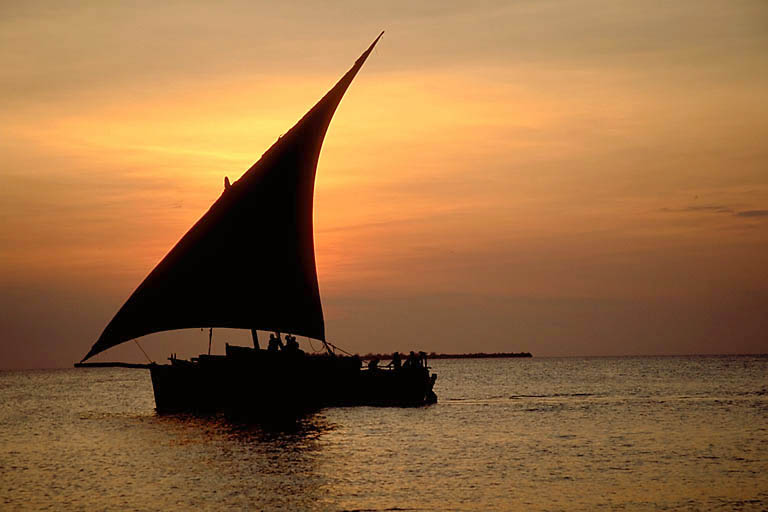
May 26-June 2: Mozambique-- White sand beaches of Praia Do Tofo. Bazaruto Archipelago. Excursion to islands [where I camp for 2 days] on the Dhow [traditional sailing vessel of the African east coast]. Snorkel at some point? Travel through coconut plantations. Enjoy lots of beach [although it will be cold :(]. Maputo.
June 3-6: South Africa-- Kruger National Park. Helping release animals back into the wild at Moholoholo Wildlife Rehabilitation Centre. Fire dancing by local Shangaan people. Wildlife walk. Panorama Route [including Blyde River Canyon and Bourkes Luck Potholes] back to Johannesburg.
Of course not all of this is guaranteed as many of these things only work as weather permits... and it is becoming winter here now [as in FREEZING] so things may change. And depends on money [sad]. But this sounds like a great plan, right? I don't even mind sleeping in a tent in the wilderness/bush for 35 nights to accomplish it! I also feel I will learn a lot from this trip and I am excited to see other cultures in southern Africa... although my Zulu language ability has improved recently so maybe I should stay here to use it [I can now say. "I am sorry, I don't understand Zulu, I am learning little by little. But, my brain is small and I do not remember well."].
I am coming back to Pietermaritzburg for a week after in order to say goodbye to everyone properly. People threw a fit when I said I was leaving the end of this month, and truth be told... I am going to miss them!
Subscribe to:
Posts (Atom)